The US-PRC Agreement on Climate Change is Not a Hallelujah for the Planet
It’s a Requiem for the Kyoto Treaty
[Update: On November 13, the spokesperson for the PRC Ministry of Foreign Affairs addressed the rather unavoidable implication that the bilateral US climate agreement with the PRC represented a break with the "BASIC" bloc--Brazil, South Africa, India, and China--which had formed to negotiate climate matters with the United States at Copenhagen. The answer was "Two signals": 1) PRC serious about climate change 2) We'll work with everybody i.e. including bilateral talks with the United States. Despite the "China maintains close communication and cooperation with other BASIC
countries and other developing countries and will continue to do so" lip service, looks like hasta la vista, BASIC and, for that matter, the G77 group of small, at-risk developing countries that the PRC was supposed to champion by insisting on the Kyoto ethos and obligations.
As to why the PRC decided to change course, I'm guessing there were geopolitical blandishments from the United States. But also, it was clear the new Modi government had decided (perhaps with some US wooing) that the BASIC structure didn't work for it.
On November 6, the Indian Express reported:
[T]he prime minister’s sherpa for the upcoming G20 meeting in Brisbane, where climate change is expected to feature heavily, proposed a new kind of decoupling. Arguing that India’s climate negotiation strategy, which has amounted to casting its lot with China, is hurting its interests, Suresh Prabhu called for the “common but differentiated responsibility (CBDR)” concept that has formed the bedrock of global climate action discussions to be applied within the so-called developing block. Prabhu points out that aligning with China clubs India in a higher per-capita emissions bracket than it needs to be in, and so limits its room for manoeuvre.
I'm guessing the PRC saw the handwriting on the wall and decided to break the bloc and deal bilaterally with the United States while it could still get a good deal.
So, a long-standing goal of US climate diplomacy--breaking the BASIC bloc and with it the pro-Kyoto solidarity of the big developing world emitters with the at-risk nations--has been achieved.
Victory!
Of course, if India's takeaway is that "more room to maneuver' translates into a deal to allow its CO2 emissions to continue to grow even past the PRC's cap date of 2030, I doubt we'll be throwing that "Global Warming Is Licked" parade any time soon.
As to the "Kyoto is dead" line, some at-risk countries haven't got the message yet, as one can read in this piece about the CARICOM (Caribbean) bloc's stated determination to continue pursuing binding caps for the developed countries.
In the run-up to the 2015 Paris conference--whose stated intention is to somehow put the wheels back on the banged-up Kyoto buggy--I suspect the disappointment and fears of the at risk countries will be handled according to the time-honored formula: lofty rhetoric and inadequate assistance for adaptation--with the promise of More to Come! if the at risk countries knuckle under and accept their miserable lot in life.
President Obama announced that the US would pony up $3 billion to the UN's "Green Climate Fund"--subject, of course, to getting the approval of the vociferously opposed Republican-controlled US Congress--and Japan announced it would also contribute $1 billion.
The "Green Climate Fund" is one of those optimistic neoliberal exercises. Its mandate:
The U.N.-backed GCF is designed to
enlist private-sector money on top of government donations, and so help
poorer countries to invest in environmentally friendly technologies and
build up their defenses against rising sea levels and less predictable
weather patterns.
Yeah, well consider this. At the Copenhagen climate conference in 2009, when the US was confronting concerted opposition to the developed world's plan to ditch the Kyoto Treaty, Hillary Clinton dangled the prospect of $100 billion per year for a fund for at risk nations.
the
prime minister’s sherpa for the upcoming G20 meeting in Brisbane, where
climate change is expected to feature heavily, proposed a new kind of
decoupling. Arguing that India’s climate negotiation strategy, which has
amounted to casting its lot with China, is hurting its interests,
Suresh Prabhu called for the “common but differentiated responsibility
(CBDR)” concept that has formed the bedrock of global climate action
discussions to be applied within the so-called developing block. Prabhu
points out that aligning with China clubs India in a higher per-capita
emissions bracket than it needs to be in, and so limits its room for
manoeuvre. B - See more at:
http://indianexpress.com/article/opinion/editorials/the-china-hyphen/#sthash.TTT7pXkJ.gcKmdQF6.dpuf
the
prime minister’s sherpa for the upcoming G20 meeting in Brisbane, where
climate change is expected to feature heavily, proposed a new kind of
decoupling. Arguing that India’s climate negotiation strategy, which has
amounted to casting its lot with China, is hurting its interests,
Suresh Prabhu called for the “common but differentiated responsibility
(CBDR)” concept that has formed the bedrock of global climate action
discussions to be applied within the so-called developing block. Prabhu
points out that aligning with China clubs India in a higher per-capita
emissions bracket than it needs to be in, and so limits its room for
manoeuvre. B - See more at:
http://indianexpress.com/article/opinion/editorials/the-china-hyphen/#sthash.TTT7pXkJ.gcKmdQF6.dpuf
the
prime minister’s sherpa for the upcoming G20 meeting in Brisbane, where
climate change is expected to feature heavily, proposed a new kind of
decoupling. Arguing that India’s climate negotiation strategy, which has
amounted to casting its lot with China, is hurting its interests,
Suresh Prabhu called for the “common but differentiated responsibility
(CBDR)” concept that has formed the bedrock of global climate action
discussions to be applied within the so-called developing block. Prabhu
points out that aligning with China clubs India in a higher per-capita
emissions bracket than it needs to be in, and so limits its room for
manoeuvre. B - See more at:
http://indianexpress.com/article/opinion/editorials/the-china-hyphen/#sthash.TTT7pXkJ.gcKmdQF6.dpuf
the
prime minister’s sherpa for the upcoming G20 meeting in Brisbane, where
climate change is expected to feature heavily, proposed a new kind of
decoupling. Arguing that India’s climate negotiation strategy, which has
amounted to casting its lot with China, is hurting its interests,
Suresh Prabhu called for the “common but differentiated responsibility
(CBDR)” concept that has formed the bedrock of global climate action
discussions to be applied within the so-called developing block. Prabhu
points out that aligning with China clubs India in a higher per-capita
emissions bracket than it needs to be in, and so limits its room for
manoeuvre. B - See more at:
http://indianexpress.com/article/opinion/editorials/the-china-hyphen/#sthash.TTT7pXkJ.gcKmdQF6.dpufthe prime minister’s sherpa for the upcoming G20 meeting in Brisbane, where climate change is expected to feature heavily, proposed a new kind of decoupling. Arguing that India’s climate negotiation strategy, which has amounted to casting its lot with China, is hurting its interests, Suresh Prabhu called for the “common but differentiated responsibility (CBDR)” concept that has formed the bedrock of global climate action discussions to be applied within the so-called developing block. Prabhu points out that aligning with China clubs India in a higher per-capita emissions bracket than it needs to be in, and so limits its room for manoeuvre. B - See more at: http://indianexpress.com/article/opinion/editorials/the-china-hyphen/the prime minister’s sherpa for the upcoming G20 meeting in Brisbane, where climate change is expected to feature heavily, proposed a new kind of decoupling. Arguing that India’s climate negotiation strategy, which has amounted to casting its lot with China, is hurting its interests, Suresh Prabhu called for the “common but differentiated responsibility (CBDR)” concept that has formed the bedrock of global climate action discussions to be applied within the so-called developing block. Prabhu points out that aligning with China clubs India in a higher per-capita emissions bracket than it needs to be in, and so limits its room for manoeuvre. B - See more at: http://indianexpress.com/article/opinion/editorials/the-china-hyphen/
the prime minister’s sherpa for the upcoming G20 meeting in Brisbane,
where climate change is expected to feature heavily, proposed a new kind
of decoupling. Arguing that India’s climate negotiation strategy, which
has amounted to casting its lot with China, is hurting its interests,
Suresh Prabhu called for the “common but differentiated responsibility
(CBDR)” concept that has formed the bedrock of global climate action
discussions to be applied within the so-called developing block. Prabhu
points out that aligning with China clubs India in a higher per-capita
emissions bracket than it needs to be in, and so limits its room for
manoeuvre. - See more at:
http://indianexpress.com/article/opinion/editorials/the-china-hyphen/#sthash.TTT7pXkJ.gcKmdQF6.dpuf
the prime minister’s sherpa for the upcoming G20 meeting in Brisbane,
where climate change is expected to feature heavily, proposed a new kind
of decoupling. Arguing that India’s climate negotiation strategy, which
has amounted to casting its lot with China, is hurting its interests,
Suresh Prabhu called for the “common but differentiated responsibility
(CBDR)” concept that has formed the bedrock of global climate action
discussions to be applied within the so-called developing block. Prabhu
points out that aligning with China clubs India in a higher per-capita
emissions bracket than it needs to be in, and so limits its room for
manoeuvre. - See more at:
http://indianexpress.com/article/opinion/editorials/the-china-hyphen/#sthash.TTT7pXkJ.gcKmdQF6.dpuf
the
prime minister’s sherpa for the upcoming G20 meeting in Brisbane, where
climate change is expected to feature heavily, proposed a new kind of
decoupling. Arguing that India’s climate negotiation strategy, which has
amounted to casting its lot with China, is hurting its interests,
Suresh Prabhu called for the “common but differentiated responsibility
(CBDR)” concept that has formed the bedrock of global climate action
discussions to be applied within the so-called developing block. Prabhu
points out that aligning with China clubs India in a higher per-capita
emissions bracket than it needs to be in, and so limits its room for
manoeuvre. - See more at:
http://indianexpress.com/article/opinion/editorials/the-china-hyphen/#sthash.TTT7pXkJ.gcKmdQF6.dpuf
the
prime minister’s sherpa for the upcoming G20 meeting in Brisbane, where
climate change is expected to feature heavily, proposed a new kind of
decoupling. Arguing that India’s climate negotiation strategy, which has
amounted to casting its lot with China, is hurting its interests,
Suresh Prabhu called for the “common but differentiated responsibility
(CBDR)” concept that has formed the bedrock of global climate action
discussions to be applied within the so-called developing block. Prabhu
points out that aligning with China clubs India in a higher per-capita
emissions bracket than it needs to be in, and so limits its room for
manoeuvre. - See more at:
http://indianexpress.com/article/opinion/editorials/the-china-hyphen/#sthash.TTT7pXkJ.gcKmdQF6.dpuf
the
prime minister’s sherpa for the upcoming G20 meeting in Brisbane, where
climate change is expected to feature heavily, proposed a new kind of
decoupling. Arguing that India’s climate negotiation strategy, which has
amounted to casting its lot with China, is hurting its interests,
Suresh Prabhu called for the “common but differentiated responsibility
(CBDR)” concept that has formed the bedrock of global climate action
discussions to be applied within the so-called developing block. Prabhu
points out that aligning with China clubs India in a higher per-capita
emissions bracket than it needs to be in, and so limits its room for
manoeuvre. - See more at:
http://indianexpress.com/article/opinion/editorials/the-china-hyphen/#sthash.TTT7pXkJ.gcKmdQF6.dpuf
I suppose the fact that I can still be amazed at the
magnitude of botched mainstream misreporting is a sign that I still retain a
sense of childlike wonder.
A HUGE deal is being made out of the US-China
climate change agreement.
The hoopla is ludicrous.
The U.S. makes a statement about its
determination to achieve non-binding targets, the PRC talks about its
determination to achieve non-binding targets.
At least the Chinese are promising to do something they’re
already planning to do and capable of doing: peaking CO2 emissions by
2030. Going green and, in particular,
dealing with the horrific smog problems in Beijing and other major Chinese
cities is a key element in the social and political pact the CCP wants to make
with China’s urban middle class, so the PRC, even if it is ready to see the
rest of the planet go to hell, has strong domestic political imperatives
driving its greenhouse gas policies.
As for the U.S. goal--26%-28% reductions in greenhouse gas emissions below 2005 levels by 2025--it’s strictly voluntary and subject to
the tender mercies of the now Republican-controlled Congress.
What happens when you combine the aspirations of the world’s
two biggest emitters of greenhouse gases?
Well, if the U.S. lives up to its commitments, it might be
able to shave off 2 trillion tons from its annual greenhouse gas emissions by
2030. At the same date, the PRC will add around 5 trillion tons per annum.
The net
result is not victory; it’s probably the
recipe for a global temperature rise
of 4 degrees which is much higher than the 2 degree rise that everybody said
would be very, very bad.
The IPCC finds
that to avoid more than 2 degrees of warming, global emissions must fall by an
average of 50 percent below 1990 levels by 2050. This requires urgent action:
Our energy systems will take decades to fully decarbonize, given the time it
takes for power plants and vehicle fleets to turnover, enabling a switch to
low-carbon alternatives.
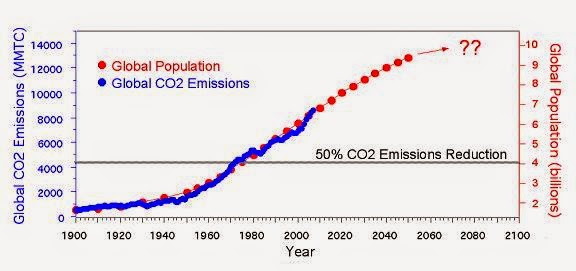
The optimistic assumption is that the United States will be able to halve its 1990 levels by 2050. For the PRC, a similar goal would involve peaking CO2 emissions in 2030...and then cutting them 90% to get back down 50% below 1990 levels. I don't see that happening. And there's India.
In 2050, I don't think we'll be partying like it's "half of 1990", CO2-wise. Might look more like this:
Assuming we f*ck up and average global temps rise 4 degrees
over the baseline, the poorer, at risk
nations take it in the neck. The richer
nations devote their resources to “adaptation” (dealing with the local
consequences of climate change) while giving lip service to “mitigation”
(trying to achieve a global remedy for the climate problem).
It’s a bitter pill, so there’s a lot of sugar-coating going
on.
Even as China’s emissions climb as a matter of absolute
tonnage released, it is praised for “reducing its carbon intensity” i.e. the
amount of carbon reduced per unit of GDP.
As for President Obama, enviros rightfully regard him as a
leader genuinely concerned about the environment, fighting the forces of
climate change evil i.e. the Republicans and their buddies in the energy
industry, and struggling to move climate change legislation forward one painful
step at a time.
So President Obama has gained outsized kudos for a rather puny
deal with China. Hopefully, bigger
things down the road. Maybe another
non-binding deal with India. Clap harder
for Tinkerbell!
A less attractive side of the climate change debate is the
political cover provided to President Obama for his most questionable and
arguably catastrophic climate change gambit: the decision to kill Kyoto i.e.
gut the Kyoto Treaty…and hope that something
better might get cobbled together in an atmosphere of heightened urgency before
it was Too Late.
Kyoto mandated legally-binding emissions caps for the “Annex
I” industrialized nations. It was unratifiable in the United States due to
Republican resistance and because its carve-out gave “Annex II” countries, particularly
China but also India, a now indefensible pass on emissions targets on "developing nation" grounds.
Al Gore tells us that back in 2009 the PRC offered to President
Obama to accept binding caps on its greenhouse gas emissions. The carrot for China would presumably be a sizable
wealth transfer to the PRC from the industrialized world as the ability to
achieve emissions goals was monetized through carbon trading enabled by
national “cap and trade” legislation in the major industrialized countries.
Maybe the Chinese offer was bullsh*t, but we never got a
chance to find out. By the time the
critical Copenhagen climate change conference rolled around end-2009, President
Obama had already squandered his political capital and Senate supermajority in
his grinding quest for health care reform and his energy legislation was DOA.
The United States showed up at Copenhagen with the
conviction that Kyoto had to go, that the United States, even though it had no
prospect of passing binding domestic legislation, would claim to have enough
leadership juice to create a viable successor system…and the PRC would be the
designated fall guy in the necessary but politically wrenching drama of
knocking off Kyoto (and spurning the needs and moral claims of the at-risk
nations that had not contributed significantly to global warming but would bear
the brunt of its effects, and were a major focus of the Kyoto treaty).
I harbor the suspicion that the United States deliberately
framed its monitoring, review, and verification requirements on China to be as intrusive
and repellent as possible—and dishonestly tied $100 billion annually of adaptation relief for poor
at-risk countries (that the United States had no ability to fund) to Chinese acceptance-- so that the PRC would be sure to reject
them.
Mission accomplished, at least for the West.
The focus was successfully drawn away from the United States
and its inability to pass cap-and-trade legislation, the cornerstone of any
Kyoto-style effort, and lay the political onus for the intense rancor at
Copenhagen on (in the words of Australia's Kevin Rudd) the “ratf*cking” Chinese.
In order to smooth the path for President Obama, some
enviros now employ the bombastic statement that “Kyoto is dead”. Indeed, the United States government, through
its climate change thug-in-chief, Todd Stern, has done its level best, having
persuaded a significant number of countries to drop out so that the only
enthusiastic major player is the European Union and Kyoto now only governs 15%
of global emissions. At the same time, Wikileaks revealed that US slowwalking of the negotiations with China on the monitoring mechanisms for the offset business (which are a key enabling mechanism for Kyoto-style binding targets combined with cap and trade) became so blatant that allies in Europe were privately asking what the heck was going on.
Even so, Kyoto, largely because of the unwillingness of the
BASIC block (Brazil, South Africa, India, and China) to abandon the pact (and
the developing world) and provide political cover for the United States, had
struggled on.
In 2012, Kyoto was extended to 2020, and a meeting planned for
Paris in 2015 to try to get the treaty and a global response to climate change on a viable
track.
The significance of the US-China agreement, and why I’m
assuming it is trumpeted with such desperate enthusiasm in the US is that the
PRC, by bilaterally coming to climate change terms with the United States, has
simultaneously spurned the Kyoto Treaty, the BASIC bloc, and the at-risk
nations (known as the G-77 bloc).
So, instead of demanding that the United States help reform
the binding Kyoto regime, the PRC has now acquiesced in the US strategy of
Kyoto destruction without making provisions for a binding successor agreement.
Whatever the PRC does or does not do on climate change, the
bilateral meeting of the minds with President Obama is a rather momentous
political step for the PRC and one is invited to wonder what luscious quid pro
quo the United States offered in return.
I’ve written extensively on the US-China climate change
gyrations since Copenhagen.
This
piece at China Matters provides a solid
introduction to the issues and links for further reading, as well as a vigorous
rip on Hillary Clinton, whose politically-driven vision of diplomacy--and the cynical "We must destroy the village in order to save it" approach to climate change policy-- I see at
the heart of the problem.
Population vs. CO2 emission graph from www.wfs.org