(Includes State Dept. briefing wrap up for 11/20 & 11/21/06)
Here’s an interesting item from the Korea Times:
China has unfrozen some North Korean accounts in a Macau bank that have been suspected of being linked to money laundering and other financial irregularities, Yonhap News Agency and KBS reported, quoting a Beijing-based diplomatic source yesterday.
The move, which seems to have been conducted with the understanding of the United States, is likely to oil the wheels in the expected resumption of the six-party talks on North Korea’s nuclear programs, reports said. The multilateral talks, which have been stalled for one year, are expected to resume as early as next month, as Pyongyang said it would return to the negotiation table late last month.
...
A North Korean official active in Beijing also confirmed the measures, adding ``it seems the United States has partly accepted our demand,’’ according to Yonhap.
Some observers interpret the move as reciprocity from the U.S. as North Korea agreed to resume the six-party talks on Pyongyang’s nuclear programs late last month.
For me, the interesting phrases are “The move, which seems to have been conducted with the understanding of the United States...” and ``it seems the United States has partly accepted our demand,’’, according to the North Koreans, no less, not exactly the most reliable source of information on U.S. intentions.
Lot of “seems” there.
Did the United States greenlight the reopening of the $12 million dollars in BDA accounts that examiners found to be legitimate? (I examined the BDA issue and the question of how much money was actually black funds here.)
Maybe.
One possibility is that the United States has given up on the big stick approach to getting North Korea to return to the Six Party talks, and decided to throw out a carrot.
On a certain level, this makes obvious sense.
The United States has failed to convince China, Russia, or South Korea to sign on to a coercive interdiction and inspection regime that would compel North Korea to make painful concessions before returning to the talks.
Secretary of State Rice failed during her whirlwind tour of the key world capitals.
President Bush failed this week at APEC.
The diplomatic string has clearly run out.
Perhaps the United States has resigned itself to re-entering the talks without a commanding position of advantage, and will participate in a protracted, muddled six-way negotiation with Kim Jung Il.
However logical this might appear, however, I wonder if President Bush was really ready to tuck his tail between his legs and accept restart of the talks on these terms.
President Bush still has almost two months of freedom of action as America’s unchecked foreign policy helmsman before the newly elected Democratic Congress is installed and severely cramps his style.
It doesn’t seem quite plausible to me that President Bush and John Bolton, who epitomize iron will, relentless energy, and imperviousness to compromise, criticism, and reality in their promotion of the Bush Doctrine, would meekly abandon their North Korea policy while any time remained on the clock.
Faced with the Bush administration’s seemingly unending and quixotic quest to obtain harsher sanctions and perhaps emboldened by President Bush’s lame duck status, China may have decided to remove the sanctions on those accounts at Banco Delta Asia as a unilateral maneuver.
In other words, perhaps the Chinese have taken a leaf from America’s book, and conducted a pre-emptive strike on the Bush administration’s position.
In this scenario, China would have pulled the sanctions unilaterally to restart the talks, and is counting on President Bush being too distracted, too weakened, and too dependent on Chinese good offices to challenge this fait accompli.
Unlikely, perhaps.
But what also seems unlikely to me is that President Bush would abandon his hard-line strategy, cut the legs out from under John Bolton, and deny him one final opportunity to seize victory in the struggle against North Korea, before the new, Democrat-controlled Congress and dissatisfied elements within his own party dispatch John Bolton, the Bush Doctrine, and President Bush’s unquestioned command of America’s foreign policy into oblivion.
Finally, here’s the Asia-related haul from the last two State Department briefings:
Nov. 20, 2006:
MR. CASEY: Chris Hill? Did we want to do Chris Hill first? Or we've still got Sri Lanka? All right, let's do Chris Hill. And basically I think most of you know that Chris is in Beijing right now to follow up on discussions that were held in Hanoi. And this is all about the process of preparing for a return to the six-party talks. His main meetings today, as I understand it, were with Vice Foreign Minister Wu Dawei, and that was the main part of his discussions there.
He does plan, as I understand it, to return to Washington sometime tomorrow after some additional meetings with Chinese officials. As he said, I think he wants to make it home for Thanksgiving. So we look forward to having him back afterwards.
QUESTION: Is he going to meet with any North Korean officials, or is that something that is planned?
MR. CASEY: There's nothing scheduled.
November 21, 2006
QUESTION: Anything more on Christopher Hill, specifically about any possible carrots offered North Korea?
MR. CASEY: Well, as you know, Chris just finished up his trip to Beijing. I think he's headed on back, if not right now, should be employed on his way back shortly from Beijing. He's had some good consultations there with his Chinese counterparts. Main focus of that has been looking at the process of how we move ourselves back into the six-party talks. And I believe you heard from him today in Beijing that he's optimistic that we might, in fact, be able to have that next round take place somewhere in the middle of December.
In terms of specifics of the consultations, I think as he said there, he wants to come back here, have a chance to talk with the Secretary and talk with other officials back here in Washington. We feel we're making good progress in having good discussions. But I certainly don't have anything specific to talk to you about in terms of how we will be proceeding in those negations. I think we'll need to let them play out in private.
Tuesday, November 21, 2006


Monday, November 20, 2006
Ao Dai!
The most wonderful and important function of the APEC summit is to humble our leaders by forcing them to don ridiculous outfits and parade for our approval like a group of beauty pageant Barbies.
Until yesterday, the prize for best (i.e. most humiliating) costume was held by South Korea.
But now Vietnam has seized the crown.
Vietnam wins, not just for gender-bending goofiness—attiring the big shots in slinky, slit-leg ao dai gowns that Westerners associate with Asian bar girls—but also for spectrum bending, eye-melting iridescent color, and the all important element of all: presentation.
For the group photo, our masters were outfitted in their gaudy finery and marooned on a little greensward in front of a (Miami) Fontainebleau white concrete folly like a clutch of exiled lawn ornaments.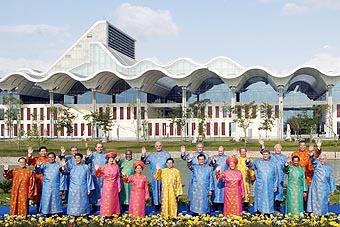
Then the befuddled heads of state had to swallow their dismay and wave and grimace awkwardly to the distant photographers as if nothing pleased them more than to appear as miniaturized, mutely gesticulating Technicolor eye candy in some bizarre Busby Berkeley meets Bollywood meets Arirang Asian-Pacific unity kitschfest.
Priceless!
Thank you Vietnam!
And thank you to Sebastien Berger of the Daily Telegraph for his in-depth report on the Ao Dai Affair.
A tight-lipped George W Bush looked especially unimpressed with his pastel blue ao dai, a flowing garment that is nowadays worn almost exclusively by women.
Next to him stood a similarly grim-looking Vladimir Putin of Russia, although Hu Jintao, the Chinese leader, appeared more comfortable.
On a slender female form the ao dai, a clinging piece of clothing slit to above the hip, is elegant and alluring, but when sported by middle-aged Caucasian men is substantially less flattering.
...
This year, the leaders had a choice of five colours of ao dai, all of them embroidered with golden lotus flowers. In feudal times yellow was reserved for the king, but it was chosen only by the Thai prime minister and the Vietnamese president, while the Sultan of Brunei, the sole monarch, picked green.
The majority wore blue — traditionally the uniform of petty officials — while all three women leaders dressed in pink.
The Guardian piles on:
Mr Bush grimaced repeatedly and shifted from foot to foot, a portrait of embarrassment in turquoise blue brocade with yellow trim. It was obvious he couldn't wait to get it off and sure enough, moments after the official photographs were taken, he strode away, ripped it off and folded it up, according to reports. His fellow leaders showed more restraint and waited until they were out of sight.
Somehow AP diplomatic correspondent Ann Gearan, apparently reporting from a parallel universe somewhere in the Gamma Quadrant, filed a dispatch claiming that our notoriously travel-detesting, multilateralism-abhorring, impatient prez was “find[ing] solace” in the welcoming East even as his own party takes advantage of his absence to prepare a fresh set of daggers to thump into his back:
A change in scenery seemed to lift President Bush as he soaked up compliments from foreign leaders who appeared nonplussed by his political troubles back home.
Having ingratiated the AP to the White House with this preposterous lede, Gearan is unable to cite a single compliment in the body of the article to support it.
Gearan also passed on this nugget:
“Asian friends will be watching the President and his team in terms of his body language, his statements, to see if he will be weakened or committed going forward with a broad and purposeful agenda in Asia as a whole.” said Kurt Campbell, a former Asia specialist at the Pentagon.
Apparently the spectacle of President Bush struggling miserably with a phosphorescent blue ao dai was enough to convince the Asian powers that U.S. wishes could be safely and profitably defied.
For the US, the APEC summit yielded an empty verbal spanking of North Korea and a sub voce unwillingness to accept U.S. framing of the North Korean situation as a crisis that demanded escalating economic pressure orchestrated through the Proliferation Security Initiative.
As usual, China was quite direct in its pronouncements, while the United States showed its usual creativity in failing to get the message:
The Chinese side expressed caution.
"We don't really think that sanctions are the purpose, rather it is the means. The UN Security [Council] resolution should not be randomly interpreted and should not be expanded," Liu said.
David McCormick, an official of the White House National Security Council, said after the meeting that the two leaders had agreed "on direction and next steps" on North Korea, but he declined to be more specific.
With the coercive sanction regime off the table as far as Russia, China, and South Korea are concerned, perhaps the United States will at last resign itself to a resumption of the Six Party Talks and months of inconclusive muddling.
Much, of course, has been made of President Bush’s lame duckery and how that further reduced the willingness of Asian governments (other than lips-and-teeth allies Japan, Australia, and Singapore) to give anything more than lip service to the president and his global security doctrine.
But there’s more to foreign policy that Iraq, Iran, and North Korea, and I believe we are now seeing the inevitable consequences of President Bush’s tunnel-visioned obsession with these failed and failing initiatives.
The Australian compared and contrasted Hu Jintao and President Bush’s experiences in Vietnam:
The difference in treatment and perceptions between Mr Bush and Mr Hu has been conspicuous in Hanoi.
The Chinese leader arrived several days before the summit for a flower-strewn schedule of smiles and ribbon-cutting intended to show Asians that Beijing, not Washington, is now the capital that counts.
A Chinese diplomat said his country had prepared for Mr Hu's trip months in advance, resulting in the announcement of a dozen economic agreements, promises to resolve border disputes with Vietnam and an agreement to share offshore exploration for oil and gas. By contrast, Mr Bush's Vietnam schedule was abruptly cut back after the US election defeat, diplomatic sources said.
Heavily protected by thousands of elite troops and police, his few public engagements have been tightly controlled.
In the soft-power scheme of things, Vietnam is pretty important to the US: emerging economic dragon, the political and military keystone of Southeast Asia, conceivably the guys who might even lease us Cam Rahn Bay. There’s no love lost between China and Vietnam, so there’s plenty of room for the US to try that hearts and minds deux thing with Vietnam.
Instead, while the Chinese are performing the painstaking diplomatic and economic spadework needed to productively manage a relationship with an important and potentially hostile neighbor, President Bush fumbles away the Permanent Normalized Trade Relations status that Vietnam covets; subjects the country to a truncated, intrusive visit that only seems to highlight how unwilling he is to be there; and spends his brief time in country agitating for a destabilizing, confrontational policy toward North Korea that is resented by all but America’s closest allies in the region.
For President Bush, obstinacy has morphed into obtuseness. Even though genuine victories in Iraq, Iran, and North Korea appear out of reach, he pursues them singlemindedly in an attempt to forestall the day of reckoning for himself and his policies.
Meanwhile, America’s other, important international interests—and the alliances and multilateral institutions that could nurture them—have been neglected.
Although President Bush is apparently oblivious to the fact that the movers and shakers of his own party as well as his nation and the world have reached the end of their patience with an obsessively failure-centric foreign policy, there are rumblings from the Right that the new Congress—with some Republicans joining the Democrats—may finally preside over the overdue demise of the Bush Doctrine.
Until yesterday, the prize for best (i.e. most humiliating) costume was held by South Korea.
But now Vietnam has seized the crown.
Vietnam wins, not just for gender-bending goofiness—attiring the big shots in slinky, slit-leg ao dai gowns that Westerners associate with Asian bar girls—but also for spectrum bending, eye-melting iridescent color, and the all important element of all: presentation.
For the group photo, our masters were outfitted in their gaudy finery and marooned on a little greensward in front of a (Miami) Fontainebleau white concrete folly like a clutch of exiled lawn ornaments.
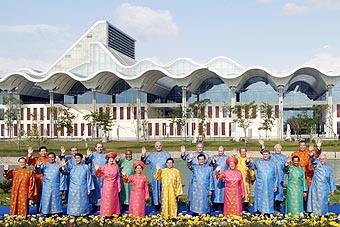
Then the befuddled heads of state had to swallow their dismay and wave and grimace awkwardly to the distant photographers as if nothing pleased them more than to appear as miniaturized, mutely gesticulating Technicolor eye candy in some bizarre Busby Berkeley meets Bollywood meets Arirang Asian-Pacific unity kitschfest.
Priceless!
Thank you Vietnam!
And thank you to Sebastien Berger of the Daily Telegraph for his in-depth report on the Ao Dai Affair.
A tight-lipped George W Bush looked especially unimpressed with his pastel blue ao dai, a flowing garment that is nowadays worn almost exclusively by women.
Next to him stood a similarly grim-looking Vladimir Putin of Russia, although Hu Jintao, the Chinese leader, appeared more comfortable.
On a slender female form the ao dai, a clinging piece of clothing slit to above the hip, is elegant and alluring, but when sported by middle-aged Caucasian men is substantially less flattering.
...
This year, the leaders had a choice of five colours of ao dai, all of them embroidered with golden lotus flowers. In feudal times yellow was reserved for the king, but it was chosen only by the Thai prime minister and the Vietnamese president, while the Sultan of Brunei, the sole monarch, picked green.
The majority wore blue — traditionally the uniform of petty officials — while all three women leaders dressed in pink.
The Guardian piles on:
Mr Bush grimaced repeatedly and shifted from foot to foot, a portrait of embarrassment in turquoise blue brocade with yellow trim. It was obvious he couldn't wait to get it off and sure enough, moments after the official photographs were taken, he strode away, ripped it off and folded it up, according to reports. His fellow leaders showed more restraint and waited until they were out of sight.
Somehow AP diplomatic correspondent Ann Gearan, apparently reporting from a parallel universe somewhere in the Gamma Quadrant, filed a dispatch claiming that our notoriously travel-detesting, multilateralism-abhorring, impatient prez was “find[ing] solace” in the welcoming East even as his own party takes advantage of his absence to prepare a fresh set of daggers to thump into his back:
A change in scenery seemed to lift President Bush as he soaked up compliments from foreign leaders who appeared nonplussed by his political troubles back home.
Having ingratiated the AP to the White House with this preposterous lede, Gearan is unable to cite a single compliment in the body of the article to support it.
Gearan also passed on this nugget:
“Asian friends will be watching the President and his team in terms of his body language, his statements, to see if he will be weakened or committed going forward with a broad and purposeful agenda in Asia as a whole.” said Kurt Campbell, a former Asia specialist at the Pentagon.
Apparently the spectacle of President Bush struggling miserably with a phosphorescent blue ao dai was enough to convince the Asian powers that U.S. wishes could be safely and profitably defied.
For the US, the APEC summit yielded an empty verbal spanking of North Korea and a sub voce unwillingness to accept U.S. framing of the North Korean situation as a crisis that demanded escalating economic pressure orchestrated through the Proliferation Security Initiative.
As usual, China was quite direct in its pronouncements, while the United States showed its usual creativity in failing to get the message:
The Chinese side expressed caution.
"We don't really think that sanctions are the purpose, rather it is the means. The UN Security [Council] resolution should not be randomly interpreted and should not be expanded," Liu said.
David McCormick, an official of the White House National Security Council, said after the meeting that the two leaders had agreed "on direction and next steps" on North Korea, but he declined to be more specific.
With the coercive sanction regime off the table as far as Russia, China, and South Korea are concerned, perhaps the United States will at last resign itself to a resumption of the Six Party Talks and months of inconclusive muddling.
Much, of course, has been made of President Bush’s lame duckery and how that further reduced the willingness of Asian governments (other than lips-and-teeth allies Japan, Australia, and Singapore) to give anything more than lip service to the president and his global security doctrine.
But there’s more to foreign policy that Iraq, Iran, and North Korea, and I believe we are now seeing the inevitable consequences of President Bush’s tunnel-visioned obsession with these failed and failing initiatives.
The Australian compared and contrasted Hu Jintao and President Bush’s experiences in Vietnam:
The difference in treatment and perceptions between Mr Bush and Mr Hu has been conspicuous in Hanoi.
The Chinese leader arrived several days before the summit for a flower-strewn schedule of smiles and ribbon-cutting intended to show Asians that Beijing, not Washington, is now the capital that counts.
A Chinese diplomat said his country had prepared for Mr Hu's trip months in advance, resulting in the announcement of a dozen economic agreements, promises to resolve border disputes with Vietnam and an agreement to share offshore exploration for oil and gas. By contrast, Mr Bush's Vietnam schedule was abruptly cut back after the US election defeat, diplomatic sources said.
Heavily protected by thousands of elite troops and police, his few public engagements have been tightly controlled.
In the soft-power scheme of things, Vietnam is pretty important to the US: emerging economic dragon, the political and military keystone of Southeast Asia, conceivably the guys who might even lease us Cam Rahn Bay. There’s no love lost between China and Vietnam, so there’s plenty of room for the US to try that hearts and minds deux thing with Vietnam.
Instead, while the Chinese are performing the painstaking diplomatic and economic spadework needed to productively manage a relationship with an important and potentially hostile neighbor, President Bush fumbles away the Permanent Normalized Trade Relations status that Vietnam covets; subjects the country to a truncated, intrusive visit that only seems to highlight how unwilling he is to be there; and spends his brief time in country agitating for a destabilizing, confrontational policy toward North Korea that is resented by all but America’s closest allies in the region.
For President Bush, obstinacy has morphed into obtuseness. Even though genuine victories in Iraq, Iran, and North Korea appear out of reach, he pursues them singlemindedly in an attempt to forestall the day of reckoning for himself and his policies.
Meanwhile, America’s other, important international interests—and the alliances and multilateral institutions that could nurture them—have been neglected.
Although President Bush is apparently oblivious to the fact that the movers and shakers of his own party as well as his nation and the world have reached the end of their patience with an obsessively failure-centric foreign policy, there are rumblings from the Right that the new Congress—with some Republicans joining the Democrats—may finally preside over the overdue demise of the Bush Doctrine.
Friday, November 17, 2006
President Bush in Vietnam: Anatomy of a Snub

A well-worn joke:
What’s the difference between Iraq and Vietnam?
George W. Bush had a plan for getting out of Vietnam.
Via the Houston Chronicle, it’s interesting, and somewhat disturbing, to be privy to President Bush’s ruminations on Vietnam:
Asked if the experience in Vietnam offered lessons for Iraq, Bush said Friday, "We tend to want there to be instant success in the world, and the task in Iraq is going to take awhile."
He said "it's just going to take a long period of time" for "an ideology of freedom to overcome an ideology of hate. Yet, the world that we live in today is one where they want things to happen immediately."
"We'll succeed unless we quit," the president said.
It seems to me that the lesson of the Vietnam War is we screwed up, we got beat, tens of thousands of Americans and millions of Vietnamese died but, hey, the sun still rises in the East, things got better, and thirty years later our President is shaking hands with the political heir of the guys who kicked our ass.
In other words, the emergence of a prosperous, peaceful Vietnam is a pretty strong argument for acknowledging the mistake we made in Iraq and, bluntly, succeeding by quitting.
Other than President Bush’s unique perspective on history, the most remarkable element of his trip to the APEC summit in Hanoi was his inability to bring with him a rather minor diplomatic concession—the award of “permanent normal trade relations” status for Vietnam.
The Vietnamese government had clearly defined PNTR, along with removal from the State Department’s “Countries of Particular Concern” religious freedom blacklist, as two matters they wanted taken care of before President Bush arrived.
The Executive Branch handled the CPC issue.
But the Republican Congress, in disarray after the catastrophe of the mid-term elections, pulled the PNTR bill.
Attempts to blame the Democrats are not particularly convincing, since Nancy Pelosi and Charles Rangel were on record favoring the bill.
Nor is it particularly plausible that the GOP in its lame-duck incarnation had suddenly decided that standing up for American jobs was more important than sending off its President on a foreign trip with a needed bill in his pocket.
My guess is Republican pique at President Bush’s high-handed but unsuccessful foreign policy—and his refusal to lower the Rumsfeld lifeboat from the S.S. Iraqitanic before the mid-term elections—had something to do with it.
And I also suspect that the surprising inability of Vietnam’s one-party Communist state to turn out an enthusiastic crowd to welcome President Bush had something to do with the fact that he came to Hanoi bringing less than he had promised.
Anatomy of a snub, courtesy of the AP, which rubs salt in the wound--and gives an indication of President Bush's emerging lame-duck status with the press--by having the temerity to mention his arch-foe, Bill Clinton not once but three times:
Lac's indifference, which appeared to be shared by many Vietnamese, was a sharp contrast to the reception that Bill Clinton received in 2000, when he became the first American president to visit since the end of the Vietnam War in 1975.
Unlike the joyous crowds that stayed up late for Clinton's unannounced midnight flight into Hanoi's international airport – a half-hour drive from downtown – Bush's late-morning arrival drew mostly the curious rather than the devoted, other than the police maintaining a security perimeter around the hotel.
...
Bush rode past billboards for multinational companies in fields where people in conical hats toiled in rice paddies, as they have for generations, before coming upon the first group of people waiting to see his motorcade pass.
“I'm here because I'm curious,” said Nguyen Van Dung, 35, who was among about 15 men at a roadside tea stall about a mile from the airport. “I want to see Bush. I like him.”
A quick straw poll of the men minutes before the motorcade arrived showed a dozen saying they liked Clinton better than Bush, while the other three viewed both men the same.
As the motorcade entered the city, more people lined the road, but most appeared to be motorbike riders forced to pull over by Bush's security escort and people drawn out of their houses and shops by the fuss.
More on BDA and North Korea
Following up on the question of whether the U.S. financial pressure exerted against Pyongyang was truly effective, a hat-tip to reader Mahathir-fan for finding an article in the Turkish press reporting that at least $8 million of the $24 million in frozen North Korean funds in the notorious Banco Delta Asia of Macau come from legitimate sources, including $2 million from those legendary nicotine buccaneers, British-American Tobacco:
Don Oberdorfer, a Korea expert, told JoongAng Ilbo newspaper that US investigators had found that "at least eight million dollars" of the funds in Banco Delta Asia (BDA) in the southern Chinese territory of Macau were legal.
Oberdorfer was quoted as saying that six million dollars belonging to Daedong Credit Bank, a Hong Kong-based joint venture, had been verified.
Also verified was two million dollars paid by British American Tobacco, which does business in the communist state.
The U.S. Treasury Department weaseled gracelessly, trying to put the onus for the freeze on the Macau banking authorities:
The US Treasury refused to comment on the claim and stressed it was the Macau government which had blocked the accounts.
Spokeswoman Molly Millerwise said BDA was blacklisted under Section 311 of the US Patriot Act "given the illicit financial activity it facilitated for the North Korean regime".
But she added: "Designations under Section 311 do not freeze funds, and any money that has been blocked in BDA has been blocked by the Macanese authorities."
Washington effectively froze the funds by blacklisting the Macau bank in September 2005, almost the same day the six-party talks made an apparent breakthrough.
The U.S. record on delivering accurate, honest, and useful intel on North Korean illicit financial transactions, clandestine shipping movements, and WMD proliferation is so dismal, it recalls unpleasant memories of how wrong the US was concerning Iraq—or how cynical the US was in manipulating intelligence in order to promote pre-existing regime change objectives there.
One would think the United States would understand that, if it wants to claim leadership of even selective—as opposed to universal--global non-proliferation initiatives, it might want to put in more effort to appear as a credible and honest broker of information.
Don Oberdorfer, a Korea expert, told JoongAng Ilbo newspaper that US investigators had found that "at least eight million dollars" of the funds in Banco Delta Asia (BDA) in the southern Chinese territory of Macau were legal.
Oberdorfer was quoted as saying that six million dollars belonging to Daedong Credit Bank, a Hong Kong-based joint venture, had been verified.
Also verified was two million dollars paid by British American Tobacco, which does business in the communist state.
The U.S. Treasury Department weaseled gracelessly, trying to put the onus for the freeze on the Macau banking authorities:
The US Treasury refused to comment on the claim and stressed it was the Macau government which had blocked the accounts.
Spokeswoman Molly Millerwise said BDA was blacklisted under Section 311 of the US Patriot Act "given the illicit financial activity it facilitated for the North Korean regime".
But she added: "Designations under Section 311 do not freeze funds, and any money that has been blocked in BDA has been blocked by the Macanese authorities."
Washington effectively froze the funds by blacklisting the Macau bank in September 2005, almost the same day the six-party talks made an apparent breakthrough.
The U.S. record on delivering accurate, honest, and useful intel on North Korean illicit financial transactions, clandestine shipping movements, and WMD proliferation is so dismal, it recalls unpleasant memories of how wrong the US was concerning Iraq—or how cynical the US was in manipulating intelligence in order to promote pre-existing regime change objectives there.
One would think the United States would understand that, if it wants to claim leadership of even selective—as opposed to universal--global non-proliferation initiatives, it might want to put in more effort to appear as a credible and honest broker of information.
US State Department Nov. 16 briefing round-up & PSI interdiction of North Korean vessel in Mayotte
The State Department briefing covered South Korea’s vote supporting a resolution condemning North Korean human rights abuses. The money quote in the VOA coverage is in the last paragraph:
Adoption of the resolution is tantamount to approval by the full General Assembly, since the committee includes all 192 U.N. member states. But it has no legal force.
This symbolic, U.S.-pleasing South Korean vote was bookended by Seoul’s reiterated refusal to join in the U.S.-led Proliferation Security Regime as the mechanism for enforcing UNSCR 1718, which sanctioned Pyongyang’s nuclear program.
The Houston Chronicle reports:
Bush sought to persuade South Korean President Roh Moo-hyun to fully implement U.N. sanctions imposed on North Korea for testing nuclear weapons. He also sought South Korea's support in the Proliferation Security Initiative, a voluntary international program that calls for stopping ships suspected of trafficking in weapons of mass destruction.
Roh said his country "is not taking part in the full scope" of the security initiative, but that it would "support the principles and goals of the PSI," and would cooperate in preventing the transfer of materiel for weapons of mass destruction in northeast Asia.
The usual spin about world support for the PSI seems even more threadbare than usual.
Faced with President Roh’s outright refusal to participate in the PSI:
The president tried to put the best face on the disagreement...
"I appreciate the cooperation we're receiving from South Korea for the Proliferation Security Initiative," Bush said.
Tony Snow also pitched in, to little avail:
Snow said South Korea promised support for the PSI program but he offered no details of Seoul's cooperation.
In this context, it’s interesting to report on a genuine PSI interdiction performed by a genuine PSI participant, France. It did not occur in international waters. The necessary pretext was that the hapless North Korean freighter called on a crumb of French land, the island of Mayotte, just off the coast of Madagascar, to unload some cement.
The Honolulu Advertiser goes on to report:
Customs and police officers first inspected the vessel at sea when it arrived in Mayotte's waters last weekend, he added. It was only the second North Korean boat in five years to dock in Mayotte, he said.
A French diplomat said the inspection started with a routine identity check Saturday. Inspectors decided to unload all the merchandise, and will continue checking the ship through the weekend, he said on condition of anonymity because of the sensitivity of the issue.
He said the inspection was slowed because the port on Mayotte is so small that the ship had to clear out several times to make way for other vessels carrying perishable cargo.
The haul so far:
A customs official in charge of maritime inspections on Mayotte said the 500-foot-long Am Noenok Gang, with 45 crew members, had been searched "from bow to stern and top to bottom."
The inspectors found a slight excess of alcohol and cigarettes but "nothing really illegal, in terms of weapons or drugs," said the official, who asked not to be identified because he was not authorized to speak to the media about the inspection.
Unless one believes that the offshore islands of Madagascar have been spun into Kim Jung Il’s web of atomic intrigue, it’s difficult to view the French action as little more than economic harassment, designed not only to bug the North Koreans by forcing them to bear the additional expense of prolonging their ship’s voyage (known as demurrage in the biz) but also putting North Korea’s few legitimate customers on alert that, if they buy from Pyongyang, it will be a big hassle and the cement probably won’t show up on time.
I believe it’s this potential use of UNSCR 1718 as a pretext for economic blockade and regime change that makes many states, including China, loath to sign on to the PSI.
With the exception of the U.S. and Japan, most of the main players in the North Korea issue want the problems solved within the context of North Korean sovereignty.
However, the PSI regime as envisioned by John Bolton and the U.S. skates uncomfortably close to undeclared economic warfare against a state that, in the U.S. view, has fallen into rogue state status and has forfeited the usual rights and protections afforded a sovereign state in the conduct of its foreign affairs.
I’ve discussed the Trojan Horse character of the PSI at length in a previous post.
With President Bush fighting a rearguard action against lame-duck status after the mid-term elections, he has signaled his continued determination to pursue the idea of U.S. global security policy unilateralism (by which the U.S. formulates policy in consultation with its allies, puts it into execution, and then presents the international system with a fait accompli and the choice of either going along or defying the United States) by renominating John Bolton, the architect and executor of this policy.
Now, given the fact that China, Russia, and South Korea are committed to regime stability in North Korea, and America's increasing desperation to disengage from Iraq demands dialogue with Iran instead of confrontation, it would seem that PSI-based interdiction and its doppelganger, US supra-UN unilateralism, are doomed to failure in both test cases.
But President Bush announces his determination to continue with these policies just the same.
It does not look like President Bush has a clear vision of what the intransigent pursuit of his policies can actually achieve. Instead, it looks like the world is being held hostage to his desire to assert his autonomy and authority even if it means continuing the pursuit of policies that are increasingly discredited and ever more likely to fail.
With that editorializing, here is the meager Asia-related crop from the November 16 press briefing.
QUESTION: South Korean Government said it will report for UN resolution condemning North Korean human rights situation this afternoon. Do you have any comment on that?
MR. GALLEGOS: No, I don't. Actually, I haven't seen anything on that. I'm sorry.
QUESTION: You don't happen to have the date on the resumption of the six party talks, do you?
MR. GALLEGOS: No. I think we've been speaking to the fact that we'd like to see it as soon as possible that we can have a meeting that will produce results and working with our partners to engage with them, and look forward to the next opportunity to do that.
QUESTION: Thank you.
Tuesday, November 14, 2006
U.S. State Dept Briefing Nov 14 2006
November 14, 2006 State Department press briefing touched on two Asia-related matters.
Re North Korea, no new date for the six party talks. Maybe the U.S. is delaying because it is still trying to get other countries on board for more aggressive sanctions so we can go into the talks from a position of strength. However, South Korea has refused to sign on the Proliferation Security Initiative to enforce UNSCR 1718 sanctions, so it looks like crushing sanctions against Pyongyang will continue to exist only in John Bolton’s fantasies.
Re China: “Chinese submarine incident”.
The Washington Times reported that the Kitty Hawk (the aircraft carrier we use to throw our weight around in the Pacific, and the naval keystone of the Proliferation Security Initiative) was “stalked” by a Chinese sub. If the sub was detected by the Kitty Hawk, it means the Chinese still have a way to go in hide and seek activities. But it is interesting that the Chinese appear willing to stick their toe in Pacific blue water, traditionally an exclusive preserve of the U.S.A.
Here’s how the Washington Post reported it:
Confirming the gist of the Washington Times report, [Admiral] Fallon said the submarine had been detected at close quarters by an aircraft carrier and its accompanying warships.
The Washington Times said the submarine had stalked the USS Kitty Hawk and surfaced within range of its torpedoes and missiles in "ocean waters" near the Japanese island of Okinawa.
"The characterization of stalking an aircraft carrier is rather sensational and I think it's probably not close to being accurate," Fallon told reporters in Malaysia, where he is attending an annual meeting of Asia-Pacific defense chiefs.
Relevant portion of the briefing below:
QUESTION: On North Korea, is there anything new and has a date been set for the bilateral talks, for any bilateral talks, and do you have the date of the six-party talks in Beijing?
MR. MCCORMACK: Nothing new on a date for the six-party talks. In terms of our preparations for the talks, those are ongoing. I expect that this is going to be another topic at the top of the list of the Secretary when she's in Vietnam. She's going to have a chance to meet also with her Japanese counterpart as well as her South Korean counterpart, so they're going to talk about preparations for the six-party talks as well as implementation of 1718.
And you had another question in there?
QUESTION: It was -- are there any bilateral talks planned?
MR. MCCORMACK: There's -- again, we get back to the old New York channel thing, but that is a mechanism that's used to pass information, exchange information. It's not a negotiating channel.
QUESTION: So there's nothing special planned during APEC?
MR. MCCORMACK: No.
QUESTION: Do you have anything about this Chinese submarine incident?
MR. MCCORMACK: No, I don't. The guys over at DOD, I think, have been talking about it quite a bit.
QUESTION: So they're going to be the lead on that? I mean, are you going to talk to the Chinese or --
MR. MCCORMACK: I don't think -- you know, we don't own any aircraft carriers here. You know, if there's a role for the State Department, then you know, then there is. I'm not aware of one in this regard.
Re North Korea, no new date for the six party talks. Maybe the U.S. is delaying because it is still trying to get other countries on board for more aggressive sanctions so we can go into the talks from a position of strength. However, South Korea has refused to sign on the Proliferation Security Initiative to enforce UNSCR 1718 sanctions, so it looks like crushing sanctions against Pyongyang will continue to exist only in John Bolton’s fantasies.
Re China: “Chinese submarine incident”.
The Washington Times reported that the Kitty Hawk (the aircraft carrier we use to throw our weight around in the Pacific, and the naval keystone of the Proliferation Security Initiative) was “stalked” by a Chinese sub. If the sub was detected by the Kitty Hawk, it means the Chinese still have a way to go in hide and seek activities. But it is interesting that the Chinese appear willing to stick their toe in Pacific blue water, traditionally an exclusive preserve of the U.S.A.
Here’s how the Washington Post reported it:
Confirming the gist of the Washington Times report, [Admiral] Fallon said the submarine had been detected at close quarters by an aircraft carrier and its accompanying warships.
The Washington Times said the submarine had stalked the USS Kitty Hawk and surfaced within range of its torpedoes and missiles in "ocean waters" near the Japanese island of Okinawa.
"The characterization of stalking an aircraft carrier is rather sensational and I think it's probably not close to being accurate," Fallon told reporters in Malaysia, where he is attending an annual meeting of Asia-Pacific defense chiefs.
Relevant portion of the briefing below:
QUESTION: On North Korea, is there anything new and has a date been set for the bilateral talks, for any bilateral talks, and do you have the date of the six-party talks in Beijing?
MR. MCCORMACK: Nothing new on a date for the six-party talks. In terms of our preparations for the talks, those are ongoing. I expect that this is going to be another topic at the top of the list of the Secretary when she's in Vietnam. She's going to have a chance to meet also with her Japanese counterpart as well as her South Korean counterpart, so they're going to talk about preparations for the six-party talks as well as implementation of 1718.
And you had another question in there?
QUESTION: It was -- are there any bilateral talks planned?
MR. MCCORMACK: There's -- again, we get back to the old New York channel thing, but that is a mechanism that's used to pass information, exchange information. It's not a negotiating channel.
QUESTION: So there's nothing special planned during APEC?
MR. MCCORMACK: No.
QUESTION: Do you have anything about this Chinese submarine incident?
MR. MCCORMACK: No, I don't. The guys over at DOD, I think, have been talking about it quite a bit.
QUESTION: So they're going to be the lead on that? I mean, are you going to talk to the Chinese or --
MR. MCCORMACK: I don't think -- you know, we don't own any aircraft carriers here. You know, if there's a role for the State Department, then you know, then there is. I'm not aware of one in this regard.
Thursday, November 02, 2006
Follow Kim Jung Il's Money--But How Far?
I think the Chinese forced North Korea back to the Six Party talks.
But David L. Asher and Stuart Levey want some credit.
In a backgrounder in today’s LA Times intended to show that we’re not just carrying Beijing’s water on North Korean policy, Asher (State Department’s point man for illicit Pyongyang activity) and Levey (Treasury undersecretary for “investigating terrorist financial webs”) talk up their globetrotting efforts to bring the North Korean financial system to its knees, in particular through the U.S. assault on Banco Delta Asia.
In the article, Asher asserts:
“Banco Delta was just a thumbtack against their skin...We knew that behind the skin was a central artery. When we pricked it, blood was going to start coming out fast.”
I think he got the pinprick part right.
We’re talking about a ridiculously small amount of money, even for North Korea—or Kim Jung Il personally, for that matter:
This July, Yomiuri Shimbun reported:
Kim was hit hard by the sanctions imposed upon the Macao bank, which froze about 24 million dollars of his personal funds, money he used to control the country, to buy Mercedes and expensive watches for high-ranking officials on festive occasions, and to buy food for ordinary people to ensure they remained loyal.
Cheong Seong Jang, a researcher at South Korea's Sejong Institute, said that without the funds Kim could not give presents to his subordinates.
A report in the Korea Times also implied that we are not talking about particularly sophisticated financial maneuvers, either by Kim Jung Il or the United States.
The U.S. government has figured out most of North Korea’s transactions in a Macau bank and believes they were mostly personal dealings involving Pyongyang’s leadership, a diplomatic source said Wednesday.
Washington has studied North Korea’s transaction records with the Banco Delta Asia, where about $24 million in cash was deposited by North Korea, but frozen by U.S. sanctions.
...
The U.S. found that the bank has produced handwritten transaction data regarding North Korea in addition to official computer records, the source said on condition of anonymity. The bank seemed to have used written records of the North Korean transactions as a way to hide them from official view, the source said.
It doesn’t look like the U.S. engaged in any particularly fancy financial forensics here.
And it doesn’t look like we cracked the North Korean criminal ops dedicated to flooding the world with meth, fake Viagra, and counterfeit U.S. currency, or got a handle on the financial channels Pyongyang uses to transact its missile sales and nuclear-related imports.
This whole thing looks less like a hammer blow against the North Korean economy and more like one of those too-clever pieces of American psy-ops—like the ban on luxury goods in the UNSCR sanctions—meant to humiliate and discredit Kim Jung Il in the eyes of the North Korean elite by forcing him to give out home-baked fruitcake and hand-knitted scarves instead of Mercedes, Rolexes, and XO as Christmas gifts to his disgruntled followers.
In other words, it looks like we got a tip and grabbed hold of Kim Jung Il’s piggy bank.
Make that one of his piggy banks.
A small one.
I would like to think that, as an iron-fisted dictator and height-challenged megalomaniac in good standing, Kim Jung Il has squirreled away more than a measly $24 million, presumably hundreds of millions, in the prestigious and secure confines of Switzerland.
Indeed, that’s what Seong Min Kim, Vice Chairman of the Exile Committee for North Korea Democracy, asserted in testimony before Congress in April 2006:
It is a well known secret that hard currency collected from sales of opium produced with forced labor from children, golds mined, collected from slave labor in the Czech, Russia and counterfeit moneys which is laundered by diplomats is deposited in the banks in Macao and Switzerland. The money is a slush fund for Kim Jung Il's personal use.
...
I implore the U.S. congress to investigate Kim Jung Il's accounts in the Switzerland banks and freeze those accounts.
Asher and Levey claimed that the move against BDA put the fear of God, or at least Uncle Sam, into other banks and made them hesitant to handle North Korea’s business.
The LA Times article states:
Privately, they threatened to go after much larger banks in Macao, including the Bank of China...which eventually froze some North Korean accounts.
You know what?
I don’t think that the United States has the balls to mess with the Swiss. Or the Chinese, for that matter, not with Beijing buying and holding gazillions of dollars of U.S. debt. And the article reports that the Russians have apparently told us to get lost when we asked them to putting the kibosh on new North Korean accounts in its big banks.
America’s is the world’s military hyperpower but financially we’re not in a position to kick anyone’s door down, unless it’s a clapped out bank in Macao.
Which is one reason why the U.S. took pains at first (hypocritical ones, as we’ll see below) to present the move against BDA as a plain vanilla enforcement move against non-state bad guy activities.
When U.S. action against Banco Delta Asia was announced, the Treasury Department met with a North Korean delegation to clarify, against all conventional wisdom, that the move was not a financial sanction.
Instead, it invoked the Patriot Act:
The Treasury Department designated BDA as a "primary money laundering concern" under Section 311 of the USA PATRIOT Act.
The Treasury Department stressed that the Section 311 action against BDA was not intended as a sanction against North Korea and should be considered matter completely separate from the Six-Party Talks, the ongoing negotiations on nuclear programs on the Korean Peninsula that involve the United States, North Korea, South Korea, China, Japan and Russia.
Regulatory action was taken against BDA primarily because of its extensive involvement with North Korean entities involved in criminal activities, according to the Treasury statement.
Post-BDA, the United States reversed course.
Using the ceaseless noodging approach that must make the United States a tiresome and unwelcome presence in international diplomatic circles, the Treasury Department has pushed to assert the viability of the BDA action as a precedent for hassling Iran:
Trouble is, last time I looked, the US has sanctions against Iran but the UN doesn’t.
So abandoning the money-laundering pretense and fast-forwarding to overt economic sanctions is a little premature.
But under the weird “my unilateralism is your multilateralism” approach that the US now takes to the international community, the U.S. is trying to create a “coalition of the willing” that would make UN action moot—and pre-empt efforts to defuse the crisis through the UN.
As the title of Edward Alden and Caroline Daniel's article in the May 7, 2006 Financial Times puts it, US seeks de facto financial sanctions on Iran:
The US is attempting to persuade European governments, banks and companies to isolate the Iranian government by engaging in de facto financial sanctions, according to US government officials and advisers.
The tactics are modelled on those used for the first time last year against North Korea. That country’s financial dealings abroad were largely cut off after Washington put pressure on Banco Delta Asia, a Macau bank the US said was facilitating illicit dealings by Pyongyang.
The risk of similar reputational damage has already caused some European banks to cut their dealings with Iran, including UBS and Credit Suisse earlier this year.
John Snow, the US Treasury secretary, last week hinted strongly at the new effort against Iran, saying: “When the US is confronted with a threat that is unreceptive to diplomatic outreach and when military action is not an option, [financial] tools are often the best authorities available to exert pressure and to wield a tangible impact.”
Well, good luck with that.
As the article points out:
Iran poses a far greater challenge than North Korea because it is far more integrated into the international financial system. Iran had $51bn of exports and $48bn of imports last year, according to the International Monetary Fund.
Proliferation of weapons of mass destruction may be bad, but threatening the international billionaires club and its favorite banks with the threat of aggressive U.S. attacks on bad guy assets in third countries is apparently worse.
However, the defiantly unilateral pursuit of unpopular policies that could only succeed with genuine multi-lateral backing (see War on Terror; see Bush Doctrine of unilateral pre-emption; see Proliferation Security Initiative) is the hallmark of the Bush administration.
In one of those revealing passages that illuminates the obstinate, self-defeating solipsism of U.S. security efforts, the LA Times article describes where de facto but piecemeal economic warfare against North Korea gets us (and I give the author, Josh Meyer, a lot of credit for inserting this perceptive caveat):
“Some former U.S. officials also worry that completely uprooting North Korea’s illicit financial network might be unwise, forcing the secretive nation to resort to tactics that could hamper U.S. efforts to spy on it.
“If you crack down in certain areas, it is like squeezing the balloon. It may pop up in an area we can’t monitor,” said John Cassara, a former Treasury and CIA money-laundering specialist.
The financial crackdown already appears to be forcing North Korea into closer arrangements with organized-crime syndicates...
That is particularly worrisome, the officials said, because these criminal outfits have a well-entrenched presence in the United States and are better at clandestinely moving money, illicit goods – and potentially, weapons of mass destruction –than terrorists.
The Bush administration has not shown itself a particularly responsible or able steward of the world’s business.
The US government’s failures in its stated area of expertise—the sophisticated collection and analysis of critical intelligence product, and its responsible, objective, and effective employment—do not appear to justify giving it a free hand to organize economic sanctions against North Korea, let alone Iran.
Therefore, I don’t think it’s going to get world support for pre-empting UN action and the Six-Party talks with some unilateral financial derring-do.
Instead of a crushing blow, Pyongyang gets a slap in the face—and the space to react and adapt.
So what does unrelenting hostility to North Korea—when the United States lacks the ability to destroy the regime and can only antagonize it and force it to become more creative and unscrupulous in its fight for survival--get us?
David Asher gives us our marching orders:
“...it’s absolutely critical for us to crack down much harder on North Korea’s ties to organized crime globally,” Asher said. “It’s going to be a much bigger challenge in my mind than even tracking terrorist finances.”
Thanks a lot.
I think it’s safe to say that driving North Korea into a global alliance with international crime to create a proliferation super-threat and a challenge greater than tracking the terrorist networks that enabled 9/11 is something that few people outside the Bush and Abe administrations would consider an acceptable outcome.
For the rest of the world, I think accommodation and containment of North Korea under Chinese auspices is regarded as a lower cost and lower risk option than giving David Asher and Stuart Levey lifetime employment pursuing an infinitely adaptive and constantly mutating illicit financial network centered on Pyongyang.
And that’s where I think the North Korean situation is headed.
But David L. Asher and Stuart Levey want some credit.
In a backgrounder in today’s LA Times intended to show that we’re not just carrying Beijing’s water on North Korean policy, Asher (State Department’s point man for illicit Pyongyang activity) and Levey (Treasury undersecretary for “investigating terrorist financial webs”) talk up their globetrotting efforts to bring the North Korean financial system to its knees, in particular through the U.S. assault on Banco Delta Asia.
In the article, Asher asserts:
“Banco Delta was just a thumbtack against their skin...We knew that behind the skin was a central artery. When we pricked it, blood was going to start coming out fast.”
I think he got the pinprick part right.
We’re talking about a ridiculously small amount of money, even for North Korea—or Kim Jung Il personally, for that matter:
This July, Yomiuri Shimbun reported:
Kim was hit hard by the sanctions imposed upon the Macao bank, which froze about 24 million dollars of his personal funds, money he used to control the country, to buy Mercedes and expensive watches for high-ranking officials on festive occasions, and to buy food for ordinary people to ensure they remained loyal.
Cheong Seong Jang, a researcher at South Korea's Sejong Institute, said that without the funds Kim could not give presents to his subordinates.
A report in the Korea Times also implied that we are not talking about particularly sophisticated financial maneuvers, either by Kim Jung Il or the United States.
The U.S. government has figured out most of North Korea’s transactions in a Macau bank and believes they were mostly personal dealings involving Pyongyang’s leadership, a diplomatic source said Wednesday.
Washington has studied North Korea’s transaction records with the Banco Delta Asia, where about $24 million in cash was deposited by North Korea, but frozen by U.S. sanctions.
...
The U.S. found that the bank has produced handwritten transaction data regarding North Korea in addition to official computer records, the source said on condition of anonymity. The bank seemed to have used written records of the North Korean transactions as a way to hide them from official view, the source said.
It doesn’t look like the U.S. engaged in any particularly fancy financial forensics here.
And it doesn’t look like we cracked the North Korean criminal ops dedicated to flooding the world with meth, fake Viagra, and counterfeit U.S. currency, or got a handle on the financial channels Pyongyang uses to transact its missile sales and nuclear-related imports.
This whole thing looks less like a hammer blow against the North Korean economy and more like one of those too-clever pieces of American psy-ops—like the ban on luxury goods in the UNSCR sanctions—meant to humiliate and discredit Kim Jung Il in the eyes of the North Korean elite by forcing him to give out home-baked fruitcake and hand-knitted scarves instead of Mercedes, Rolexes, and XO as Christmas gifts to his disgruntled followers.
In other words, it looks like we got a tip and grabbed hold of Kim Jung Il’s piggy bank.
Make that one of his piggy banks.
A small one.
I would like to think that, as an iron-fisted dictator and height-challenged megalomaniac in good standing, Kim Jung Il has squirreled away more than a measly $24 million, presumably hundreds of millions, in the prestigious and secure confines of Switzerland.
Indeed, that’s what Seong Min Kim, Vice Chairman of the Exile Committee for North Korea Democracy, asserted in testimony before Congress in April 2006:
It is a well known secret that hard currency collected from sales of opium produced with forced labor from children, golds mined, collected from slave labor in the Czech, Russia and counterfeit moneys which is laundered by diplomats is deposited in the banks in Macao and Switzerland. The money is a slush fund for Kim Jung Il's personal use.
...
I implore the U.S. congress to investigate Kim Jung Il's accounts in the Switzerland banks and freeze those accounts.
Asher and Levey claimed that the move against BDA put the fear of God, or at least Uncle Sam, into other banks and made them hesitant to handle North Korea’s business.
The LA Times article states:
Privately, they threatened to go after much larger banks in Macao, including the Bank of China...which eventually froze some North Korean accounts.
You know what?
I don’t think that the United States has the balls to mess with the Swiss. Or the Chinese, for that matter, not with Beijing buying and holding gazillions of dollars of U.S. debt. And the article reports that the Russians have apparently told us to get lost when we asked them to putting the kibosh on new North Korean accounts in its big banks.
America’s is the world’s military hyperpower but financially we’re not in a position to kick anyone’s door down, unless it’s a clapped out bank in Macao.
Which is one reason why the U.S. took pains at first (hypocritical ones, as we’ll see below) to present the move against BDA as a plain vanilla enforcement move against non-state bad guy activities.
When U.S. action against Banco Delta Asia was announced, the Treasury Department met with a North Korean delegation to clarify, against all conventional wisdom, that the move was not a financial sanction.
Instead, it invoked the Patriot Act:
The Treasury Department designated BDA as a "primary money laundering concern" under Section 311 of the USA PATRIOT Act.
The Treasury Department stressed that the Section 311 action against BDA was not intended as a sanction against North Korea and should be considered matter completely separate from the Six-Party Talks, the ongoing negotiations on nuclear programs on the Korean Peninsula that involve the United States, North Korea, South Korea, China, Japan and Russia.
Regulatory action was taken against BDA primarily because of its extensive involvement with North Korean entities involved in criminal activities, according to the Treasury statement.
Post-BDA, the United States reversed course.
Using the ceaseless noodging approach that must make the United States a tiresome and unwelcome presence in international diplomatic circles, the Treasury Department has pushed to assert the viability of the BDA action as a precedent for hassling Iran:
Trouble is, last time I looked, the US has sanctions against Iran but the UN doesn’t.
So abandoning the money-laundering pretense and fast-forwarding to overt economic sanctions is a little premature.
But under the weird “my unilateralism is your multilateralism” approach that the US now takes to the international community, the U.S. is trying to create a “coalition of the willing” that would make UN action moot—and pre-empt efforts to defuse the crisis through the UN.
As the title of Edward Alden and Caroline Daniel's article in the May 7, 2006 Financial Times puts it, US seeks de facto financial sanctions on Iran:
The US is attempting to persuade European governments, banks and companies to isolate the Iranian government by engaging in de facto financial sanctions, according to US government officials and advisers.
The tactics are modelled on those used for the first time last year against North Korea. That country’s financial dealings abroad were largely cut off after Washington put pressure on Banco Delta Asia, a Macau bank the US said was facilitating illicit dealings by Pyongyang.
The risk of similar reputational damage has already caused some European banks to cut their dealings with Iran, including UBS and Credit Suisse earlier this year.
John Snow, the US Treasury secretary, last week hinted strongly at the new effort against Iran, saying: “When the US is confronted with a threat that is unreceptive to diplomatic outreach and when military action is not an option, [financial] tools are often the best authorities available to exert pressure and to wield a tangible impact.”
Well, good luck with that.
As the article points out:
Iran poses a far greater challenge than North Korea because it is far more integrated into the international financial system. Iran had $51bn of exports and $48bn of imports last year, according to the International Monetary Fund.
Proliferation of weapons of mass destruction may be bad, but threatening the international billionaires club and its favorite banks with the threat of aggressive U.S. attacks on bad guy assets in third countries is apparently worse.
However, the defiantly unilateral pursuit of unpopular policies that could only succeed with genuine multi-lateral backing (see War on Terror; see Bush Doctrine of unilateral pre-emption; see Proliferation Security Initiative) is the hallmark of the Bush administration.
In one of those revealing passages that illuminates the obstinate, self-defeating solipsism of U.S. security efforts, the LA Times article describes where de facto but piecemeal economic warfare against North Korea gets us (and I give the author, Josh Meyer, a lot of credit for inserting this perceptive caveat):
“Some former U.S. officials also worry that completely uprooting North Korea’s illicit financial network might be unwise, forcing the secretive nation to resort to tactics that could hamper U.S. efforts to spy on it.
“If you crack down in certain areas, it is like squeezing the balloon. It may pop up in an area we can’t monitor,” said John Cassara, a former Treasury and CIA money-laundering specialist.
The financial crackdown already appears to be forcing North Korea into closer arrangements with organized-crime syndicates...
That is particularly worrisome, the officials said, because these criminal outfits have a well-entrenched presence in the United States and are better at clandestinely moving money, illicit goods – and potentially, weapons of mass destruction –than terrorists.
The Bush administration has not shown itself a particularly responsible or able steward of the world’s business.
The US government’s failures in its stated area of expertise—the sophisticated collection and analysis of critical intelligence product, and its responsible, objective, and effective employment—do not appear to justify giving it a free hand to organize economic sanctions against North Korea, let alone Iran.
Therefore, I don’t think it’s going to get world support for pre-empting UN action and the Six-Party talks with some unilateral financial derring-do.
Instead of a crushing blow, Pyongyang gets a slap in the face—and the space to react and adapt.
So what does unrelenting hostility to North Korea—when the United States lacks the ability to destroy the regime and can only antagonize it and force it to become more creative and unscrupulous in its fight for survival--get us?
David Asher gives us our marching orders:
“...it’s absolutely critical for us to crack down much harder on North Korea’s ties to organized crime globally,” Asher said. “It’s going to be a much bigger challenge in my mind than even tracking terrorist finances.”
Thanks a lot.
I think it’s safe to say that driving North Korea into a global alliance with international crime to create a proliferation super-threat and a challenge greater than tracking the terrorist networks that enabled 9/11 is something that few people outside the Bush and Abe administrations would consider an acceptable outcome.
For the rest of the world, I think accommodation and containment of North Korea under Chinese auspices is regarded as a lower cost and lower risk option than giving David Asher and Stuart Levey lifetime employment pursuing an infinitely adaptive and constantly mutating illicit financial network centered on Pyongyang.
And that’s where I think the North Korean situation is headed.
Subscribe to:
Posts (Atom)